
Maintain muscle while losing weight
What training, nutrition and sleep can mean for your body composition.
Weight loss is not the same as fat loss
During a period with less energy intake, your weight can change due to fat, lean mass, fluid and glycogen. A drop on the scale therefore does not in itself tell you what is happening to your muscle mass.
Use multiple signals: your weight trend, how your training is going, your nutritional intake and how you feel. None of those signals in themselves is a direct measure of muscle maintenance.
Nutrition in the context of your goal
The review by Helms and colleagues discusses higher protein intake during competition preparation in natural bodybuilders. The bandwidths mentioned belong to that specific context; they are not a fixed limit below which everyone loses muscle.
Vytrix shows how many calories and protein you have logged against your set goals. Those goals and product data remain something to monitor. The app cannot replace individual nutritional advice or measurement of your muscle mass.
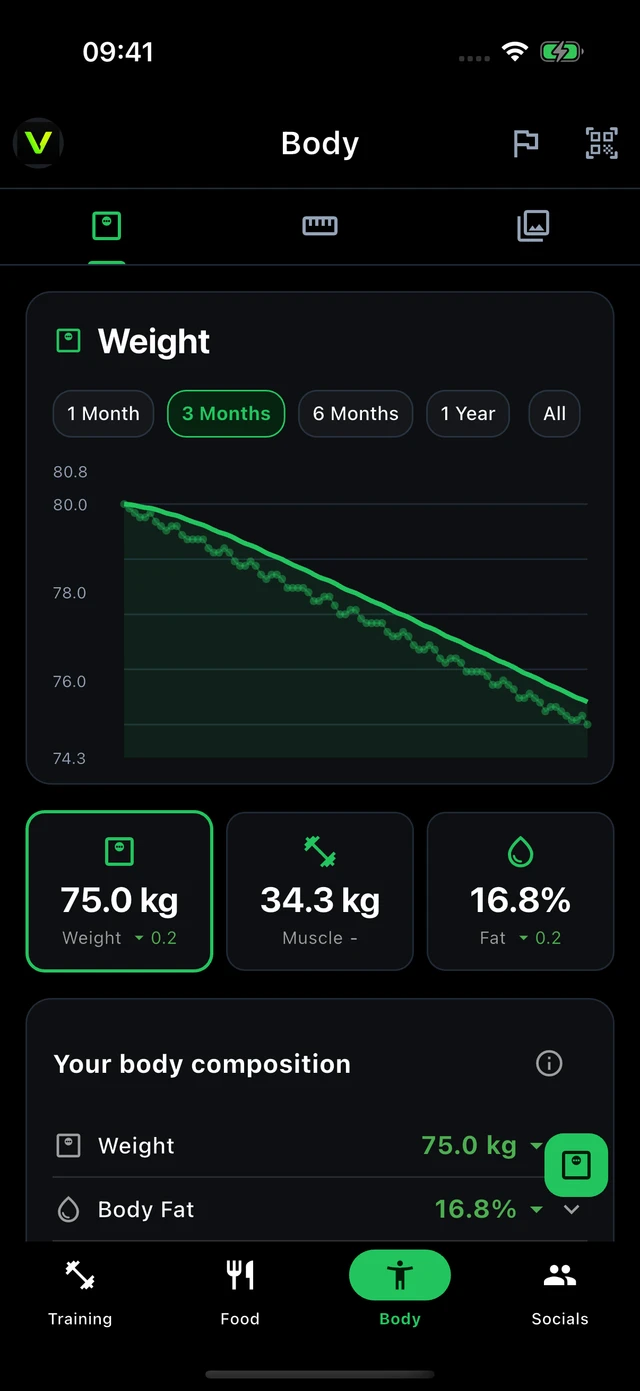
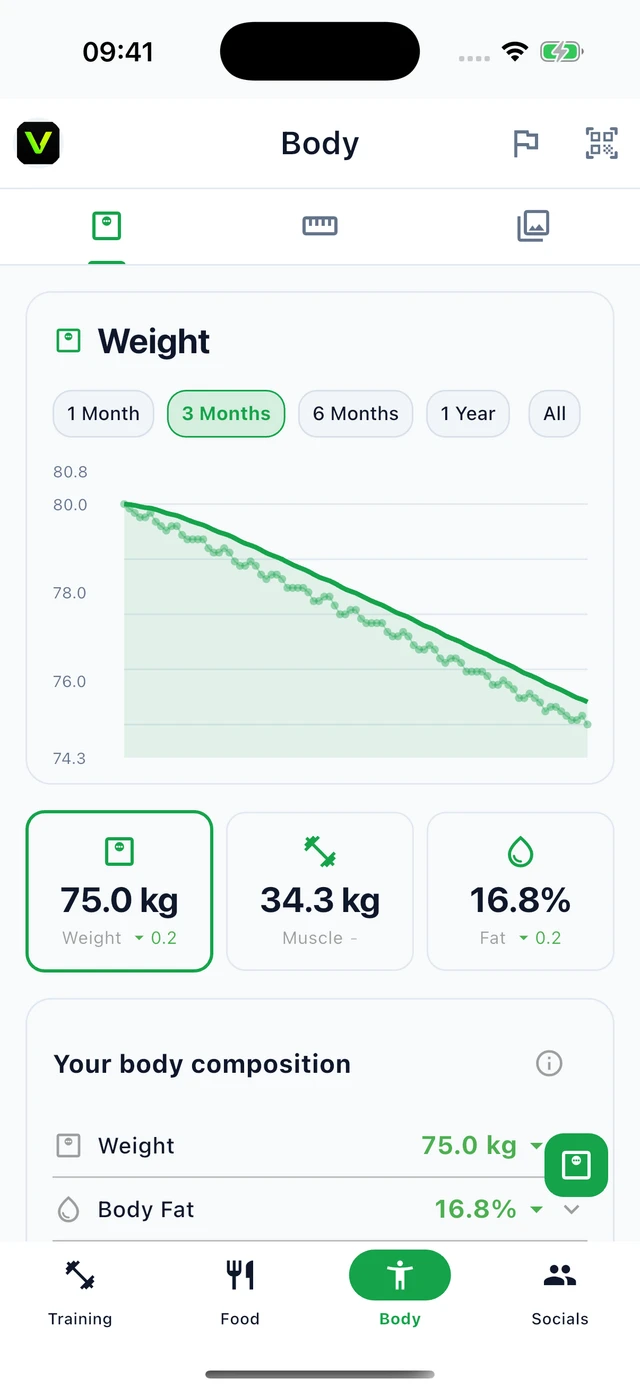
Make your progress visible
Track your weight over a longer period of time and also view your training and nutritional intake. A separate weight measurement does not tell you how much muscle mass you have retained.
Real app image · example dataKeep up your training
Strength training and sufficient recovery are relevant points of attention when you want to change your body composition. Note what loads and reps you perform and how hard the sets feel.
Research into training volume shows, on average, a correlation between weekly sets and muscle growth. This does not give an exact number of sets that guarantee muscle maintenance for everyone during an energy deficit. In the app you can view your own volume and performance side by side over several weeks.
Assess pace and sleep together
Helms and colleagues discuss approximately 0,5–1% body weight per week in competition preparation of natural bodybuilders. That range is not a general personal safety limit. The BMR lower limit in our web calculator is also a calculation rule, not a safety guarantee.
In a small, short-term study, Nedeltcheva and colleagues found that less sleep time during an energy deficit was associated with less fat loss and more loss of lean mass. That finding shows that sleep can be relevant; the percentages from that study do not predict your results.
Sources
- Helms, E. R. et al. (2014) — Evidence-based recommendations for natural bodybuilding contest preparation: nutrition and supplementation
- Schoenfeld, B. J. et al. (2017) — Dose-response relationship between weekly resistance training volume and increases in muscle mass
- Nedeltcheva, A. V. et al. (2010) — Insufficient sleep undermines dietary efforts to reduce adiposity
No external expert review has yet been published for this page. Learn how we create our content. Do you see an error or are you missing a source? corrections@vytrix.app