
How many sets per muscle group per week?
Why Vytrix tracks your volume per muscle group, and where MEV, MAV and MRV come from.
Why sets count
For muscle growth, training volume is one of the most important buttons. In practice, the simplest useful measure is: how many hard work sets does a muscle group receive per week?
Vytrix therefore not only counts total volume in kilos, but also weekly sets per muscle group. For example, a set of bench presses counts directly for the chest and partly for the triceps and front of the shoulders. Warm-ups and light drop sets do not count as a full hypertrophy stimulus.
The basics: more volume helps, to a point
Schoenfeld, Ogborn and Krieger found a dose-response relationship in their meta-analysis: higher weekly set volumes produce on average more hypertrophy than low volumes. The known practical limit from this literature is that 10+ sets per muscle group per week often works better than less than 5 sets.
But "more" does not mean infinitely better. The response levels off, recovery varies per person, and muscles differ in how much volume they can handle. That's why Vytrix uses zones instead of one hard number.
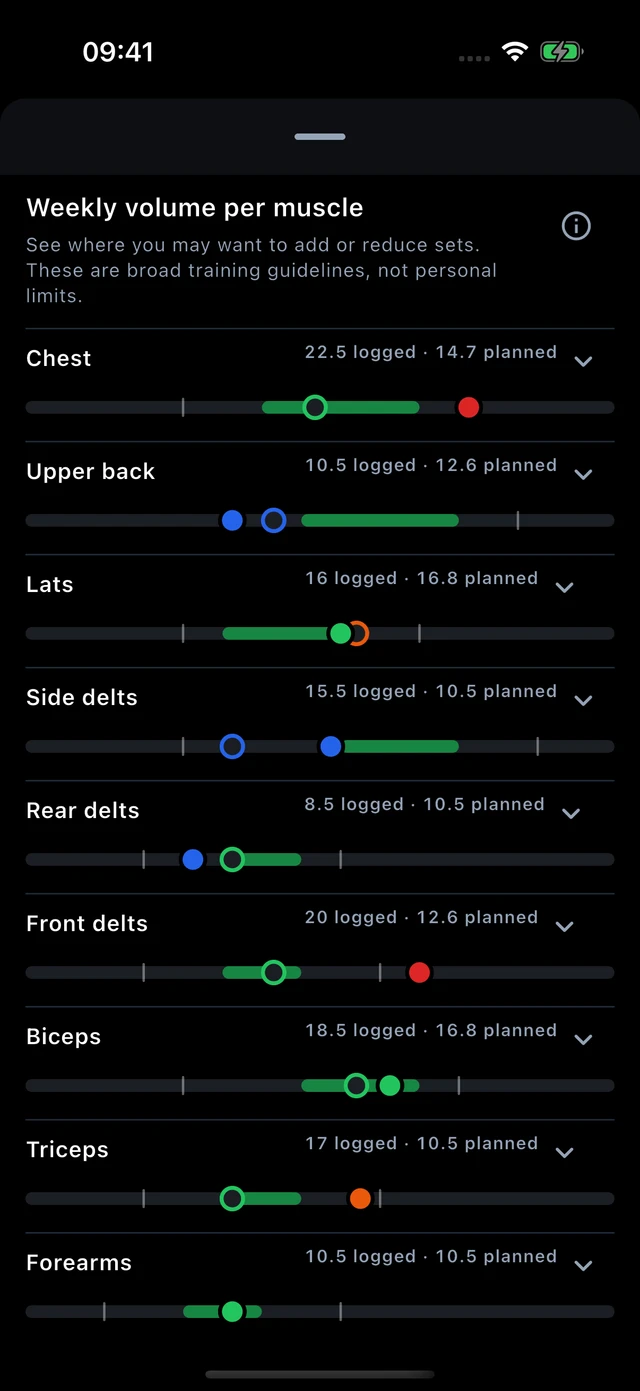
From logging sets to understanding volume
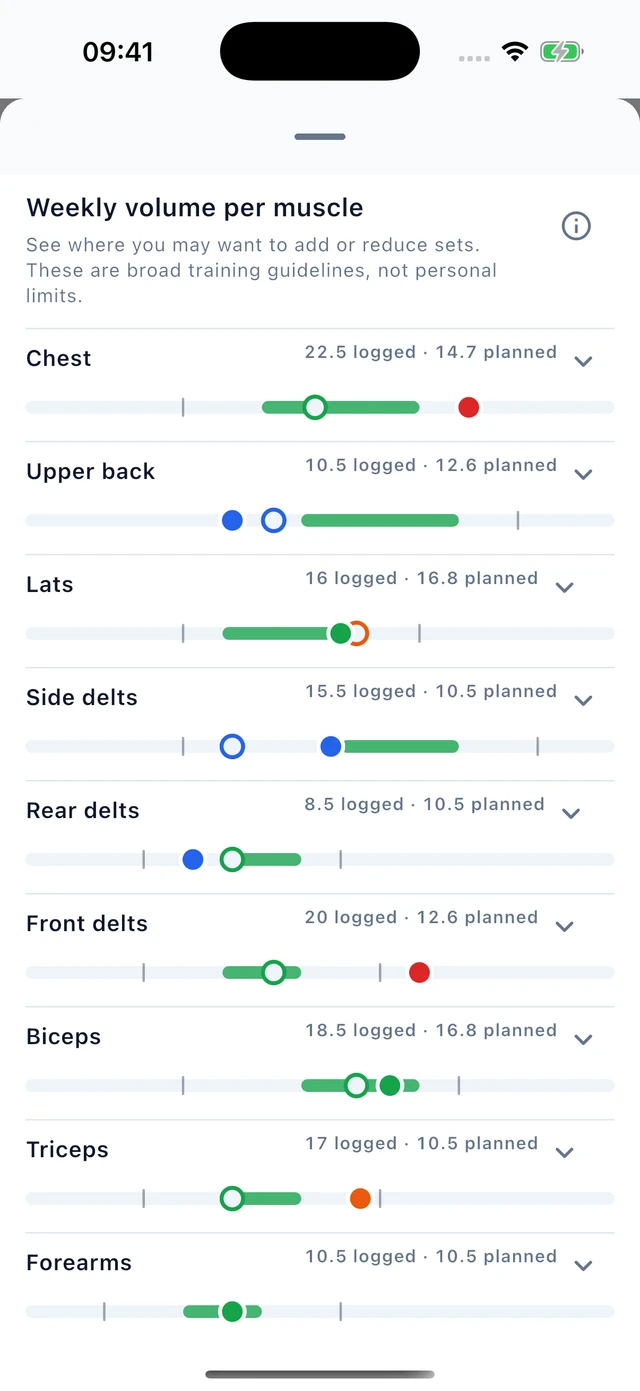
Coach shows your planned and logged weekly volume per muscle group. The colored areas are broad guidelines, not measured personal boundaries. This insight belongs to Pro.
Real app image · example dataMEV, MAV and MRV in plain language
MEV stands for minimum effective volume: approximately the minimum number of weekly work sets in which a muscle group still receives a growth stimulus for most lifters. MAV stands for maximum adaptive volume: the zone in which stimulus and recovery are usually best balanced. MRV stands for maximum recoverable volume: above this, fatigue accumulates faster than you recover.
These terms come from the practical hypertrophy literature and coaching models such as Renaissance Periodization. They are not clinically exact limits. Vytrix uses them as navigation: too low = probably understimulation, in zone = good starting point, well above MRV = recovery risk.
What ranges does Vytrix use?
The app tracks 15 muscle buckets: chest, upper back, lats, traps, front of shoulder, side of shoulder, back of shoulder, biceps, triceps, forearms, quads, hamstrings, glutes, calves and abs.
Most major muscle groups get a MAV zone around 10-20 sets per week. Some muscles are located lower, such as traps or forearms, and some can tolerate more direct or indirect sets, such as side of shoulder or upper back. Vytrix counts direct sets as 1.0 and secondary involvement as 0.5 set, so that compound exercises are not overestimated but also do not disappear from the distribution.
Frequency is mainly distribution
How often you train a muscle is important, but mainly because it helps you distribute volume. Ten sets of chest in one session is less recoverable for many people than five sets on Monday and five sets on Thursday.
Meta-analyses on training frequency show that higher frequency often seems better, but that much of that advantage disappears when total weekly volume is kept the same. That is why Vytrix first focuses on weekly sets and uses frequency mainly as a practical division of those sets.
Why Vytrix also shows planned volume
A deload or rest week may have few logged sets, while your routine is normally well structured. That's why Vytrix shows not only logged volume, but also planned weekly sets from your active routine.
That makes the difference between "you have done little this week" and "your program is structurally too low or too high for this muscle group". The first is context; the second is a programming signal.
How to read the map
Read the marker for logged sets and that for planned sets together with the colored reference area. The colors provide context for broad guidelines; they do not measure where your personal optimal or maximum volume is.
The best interpretation is trend-based. One strange week doesn't say much. Three to six weeks in which the chest is structurally below MEV or the quads are consistently above MRV is valuable feedback.
Sources
- Schoenfeld, B. J. et al. (2017) — Dose-response relationship between weekly resistance training volume and increases in muscle mass: a systematic review and meta-analysis. Journal of Sports Sciences
- Baz-Valle, E. et al. (2022) — A systematic review of the effects of different resistance training volumes on muscle hypertrophy. Journal of Human Kinetics
- Schoenfeld, B. J. et al. (2016) — Effects of resistance training frequency on measures of muscle hypertrophy: a systematic review and meta-analysis. Sports Medicine
- Schoenfeld, B. J., Grgic, J. & Krieger, J. (2019) — How many times per week should a muscle be trained to maximize muscle hypertrophy? Journal of Sports Sciences
- Schoenfeld, B. J. et al. (2019) — Resistance training volume enhances muscle hypertrophy but not strength in trained men. Medicine and Science in Sports and Exercise
- Schoenfeld, B. J. et al. (2022) — Resistance training variables for optimization of muscle hypertrophy: an umbrella review. Frontiers in Sports and Active Living
No external expert review has yet been published for this page. Learn how we create our content. Do you see an error or are you missing a source? corrections@vytrix.app