
Calorie goals: what the BMR lower limit does and doesn't mean
The lower limit in the web calculator is a calculation rule, not a personal safety guarantee.
A lower limit in the calculation model
BMR is an estimate of resting energy expenditure. The Vytrix web calculator limits the calculated calorie goal to this value if a selected weekly goal would otherwise be lower. This is a product rule; BMR is not a universal limit for determining whether a diet is safe or appropriate for a person.
The app may use additional settings and calculations. Therefore, check the explanation of the calorie goal in the app instead of assuming that every number from the web calculator matches exactly.
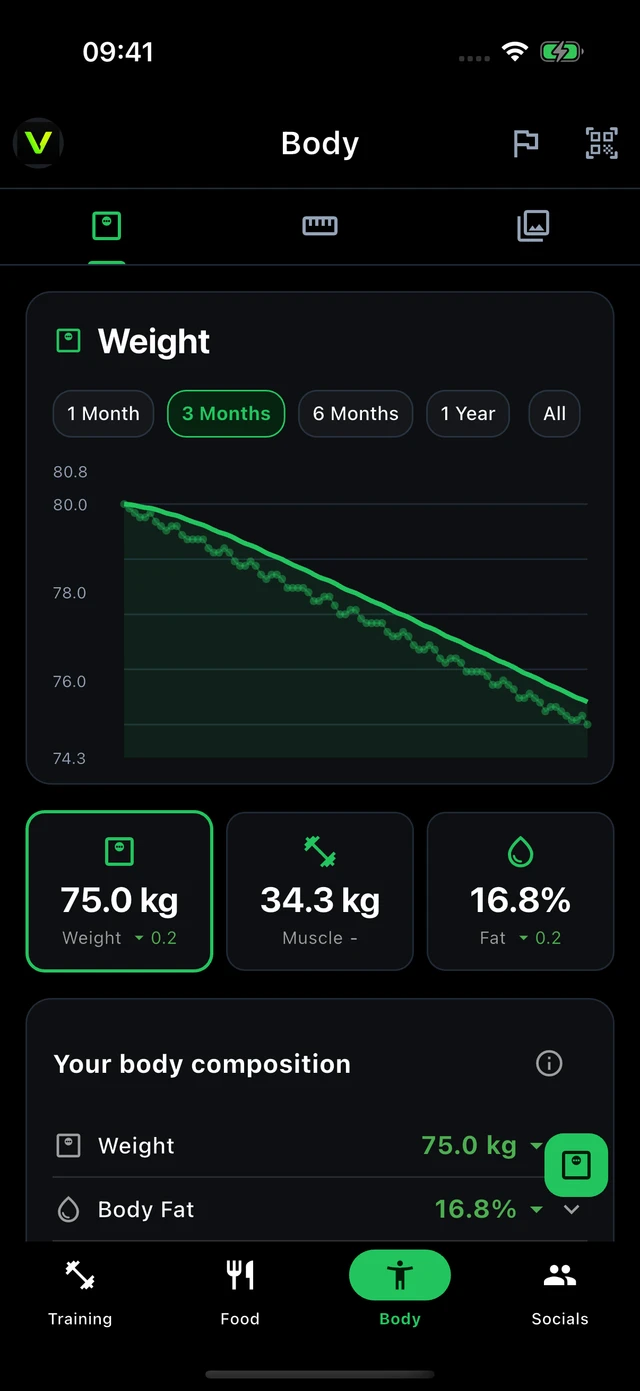
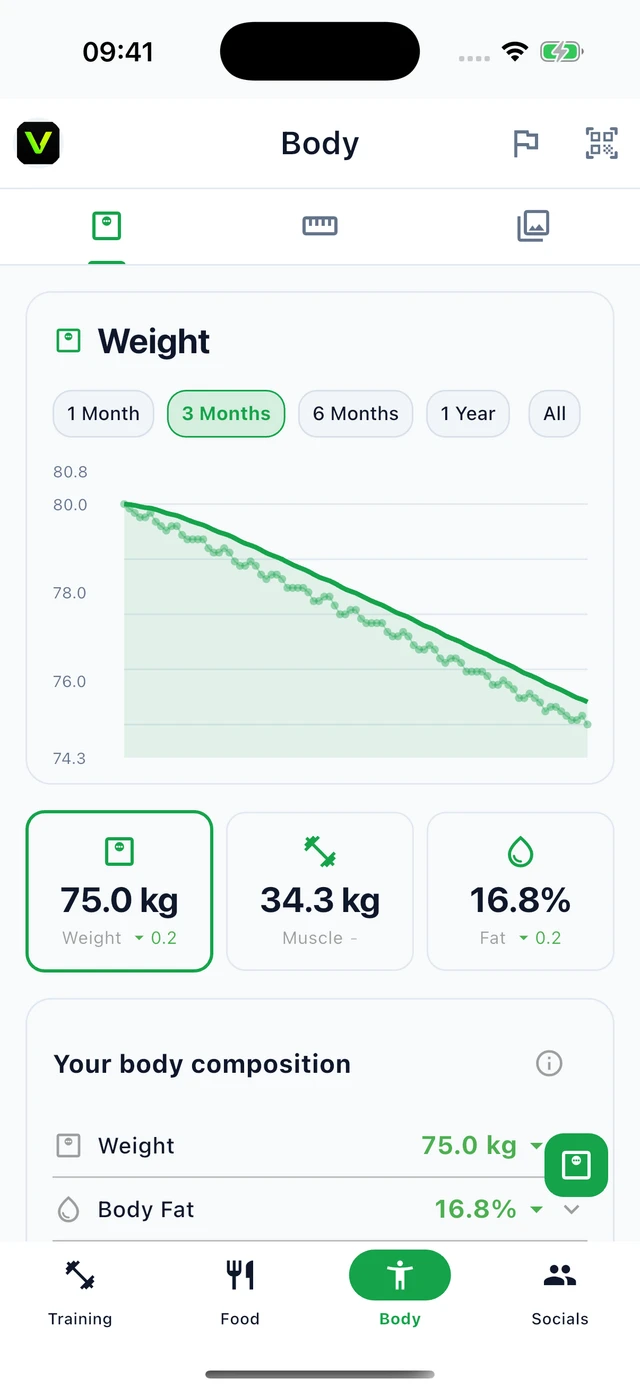
Follow what's really changing
The weight overview shows your measurements and trend. This demographic chart illustrates the view, without predicting a personal outcome.
Real app image · example dataHow the web calculator calculates
The calculator converts a chosen weight change with 7.700 kcal per kilogram and spreads this over seven days. A negative weekly goal means losing weight. The calculated calorie target is TDEE plus that daily change, after which the BMR cutoff is applied.
The space between TDEE and BMR can be expressed as a positive number as (TDEE − BMR) × 7 / 7.700 kilograms per week. The calculator saves weight loss as a negative weekly goal. This simple conversion does not predict exact fat loss: fluid, glycogen, changing energy use and other factors influence weight.
Weight progression at 0.5%, 0.75% and 1.0% cut per week (start 80 kg)
Three mathematical examples with a fixed percentage of weight change per week. Helms et al. (2014) discuss 0,5–1,0% per week in competition preparation of natural bodybuilders. These are not personal predictions or recommended defaults.
Pace in the right context
Helms and colleagues describe approximately 0,5–1% body weight per week in the specific context of competition preparation in natural bodybuilders, with the maintenance of lean body mass as a focus. That is not a general personal prescription.
Track your actual trend and training performance. A calculation example can help you understand a goal, but does not determine what pace is appropriate for your health and circumstances.
Sources
- Helms, E. R. et al. (2014) — Evidence-based recommendations for natural bodybuilding contest preparation: nutrition and supplementation. J Int Soc Sports Nutr
- Trexler, E. T. et al. (2014) — Metabolic adaptation to weight loss: implications for the athlete. J Int Soc Sports Nutr
- Mifflin, M. D. et al. (1990) — A new predictive equation for resting energy expenditure in healthy individuals. Am J Clin Nutr
- Hall, K. D. (2008) — What is the required energy deficit per unit weight loss? Int J Obes
No external expert review has yet been published for this page. Learn how we create our content. Do you see an error or are you missing a source? corrections@vytrix.app
Weight progression at 0.5%, 0.75% and 1.0% cut per week (start 80 kg)
Three mathematical examples with a fixed percentage of weight change per week. Helms et al. (2014) discuss 0,5–1,0% per week in competition preparation of natural bodybuilders. These are not personal predictions or recommended defaults.