
The science behind Vytrix Coach
How the app decides when you need more reps, more weight or a quieter week.
No black box
Vytrix Coach is deliberately not a magical AI coach. The app uses rule-based progression: you log your work sets, Vytrix looks at reps, weight, RIR, recent stagnation and your training block, and shows why a suggestion appears.
That's important. When training you want reproducible decisions: the same input must produce the same outcome. Therefore, Vytrix uses explicit rules for progression, deloads and readiness instead of unverifiable language model advice.
Progressive overload: reps or weight
The basis is progressive overload: your body adapts when the training stimulus increases over time. This does not always have to be done through heavier weight. It can also be done through more reps with the same weight, more quality work sets, or better performance at the same RIR.
Therefore, Vytrix not only shows "more weight", but also "more reps". Plotkin et al. compared load progression with rep progression over a 8-week training block and concluded that both routes are useful for muscle and strength adaptation. In practical terms, that means: if you're not ready for a weight increase yet, an extra rep can still be real progression.
Why double progression is the standard
For most lifters, Vytrix Coach is built around double progression. You train within a rep range, for example 6-10 or 8-12. If you reach the top of that range on your work sets with enough reps in reserve, you can increase the weight. If you are still below the top, the app will keep the weight the same and you will aim for more reps.
This approach is practical because it combines strength and hypertrophy. Beginners can often continue to add weight in a linear manner, but for intermediates this quickly becomes too aggressive. Double progression increases the stimulus without putting maximum strain on the nervous system each session.
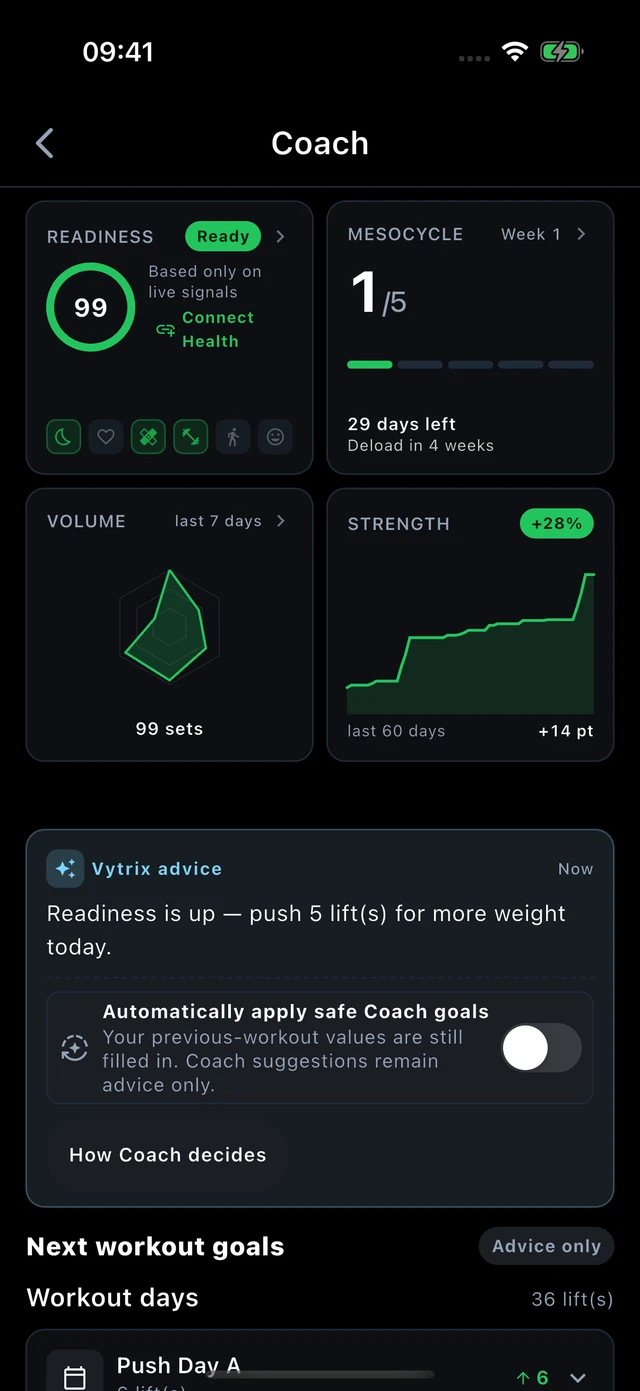
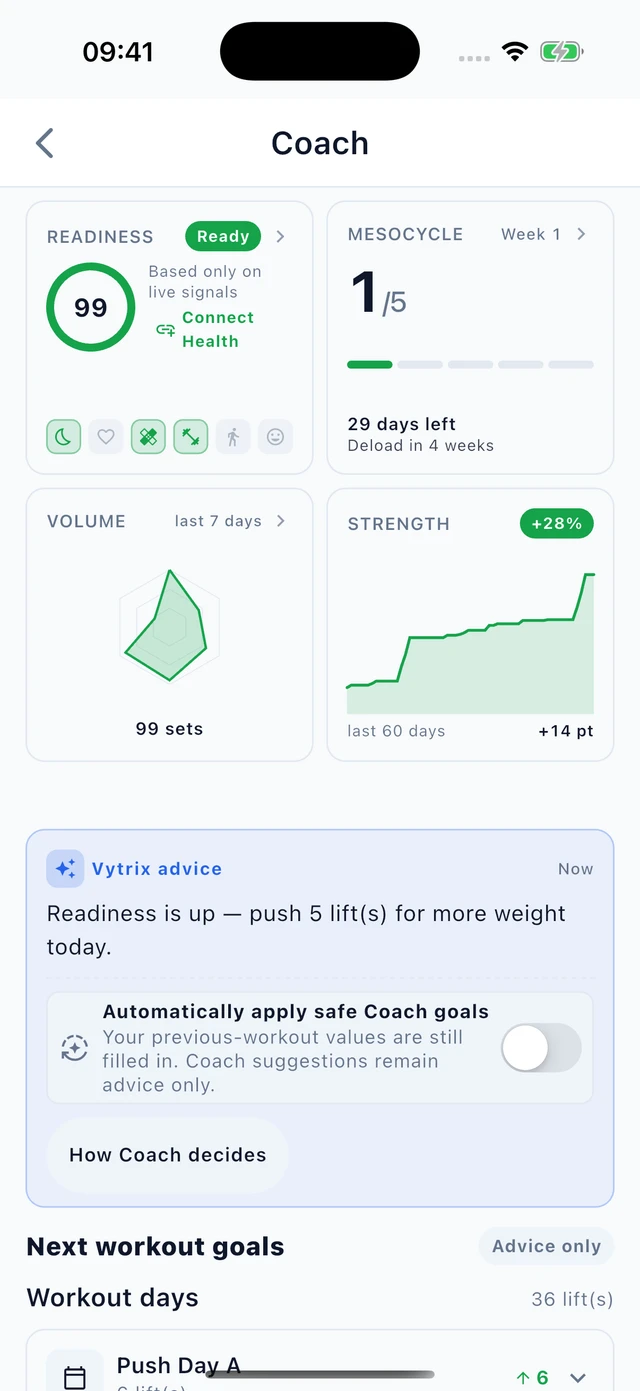
This is how you see Coach in the app
The Coach dashboard brings together your training block, volume and progression suggestions. You can see how advice is created and choose whether to apply it. This dashboard belongs to Pro.
Real app image · example dataRIR prevents overly aggressive jumps
A set may have technically been "achieved" when it was actually too heavy. If you hit 10 reps but finished at RIR 0, you had no reps left. Vytrix therefore uses RIR as a brake on weight jumps: a bump only makes sense if the top of the rep range doesn't feel like a maximum grind.
Zourdos et al. validated a resistance training-specific RPE/RIR scale. The practical nuance is: RIR is not a perfect sensor. It works better for experienced lifters and especially close to failure. That's why Vytrix uses it conservatively: as additional context, not as the only truth.
Mesocycles: blocks instead of individual days
A mesocycle is a training block. In Vytrix, such a block groups your progress into weeks: where are you in the current push, when will the lighter week come, and what has improved over the block?
Periodization is especially strongly substantiated for strength development. Moesgaard et al. found in a meta-analysis that periodized training, at the same volume, was more beneficial for 1RM strength than non-periodized training. The evidence for muscle mass is less clear. That's why Vytrix uses the cycle mainly as a structure and feedback window, not as a claim that everyone needs exactly the same schedule.
Deloads: useful, but not magical
A deload is a period with less training stress. This could be fewer sets, less weight, fewer exercises, training further from failure, or a combination of these. The goal is to reduce fatigue so that the next training phase runs better.
The science around deloads is less solid than the science around progressive overload. Bell et al. developed practical principles for deloads in strength and physical sports through an international Delphi consensus. Coleman et al. later showed that a full week without training in a high-volume block did not clearly damage hypertrophy, but also did not automatically improve strength. That's why Vytrix sees deloads as fatigue management: useful for stagnation, low readiness or the end of a heavy block, but not a sacred calendar rule.
What Vytrix does with this
In the app this means in concrete terms: warm-up sets do not count towards progression; working sets drive the suggestion; top of rep range plus enough RIR can increase weight; keep weight below the top and try to increase Coach reps; multiple stalls can provide a deload suggestion.
So the strong claim is not "Vytrix perfectly predicts what your body can do tomorrow". The honest claim is stronger: Vytrix translates proven training principles into transparent, verifiable rules that help you make consistent progress.
Sources
- Plotkin, D. et al. (2022) — Progressive overload without progressive load? The effects of load or repetition progression on muscular adaptations. PeerJ
- Moesgaard, L. et al. (2022) — Effects of periodization on strength and muscle hypertrophy in volume-equated resistance training programs: a systematic review and meta-analysis. Sports Medicine
- Zourdos, M. C. et al. (2016) — Novel resistance training-specific rating of perceived exertion scale measuring repetitions in reserve. Journal of Strength and Conditioning Research
- Helms, E. R. et al. (2018) — Application of the repetitions in reserve-based rating of perceived exertion scale for resistance training. Strength and Conditioning Journal
- Bell, L. et al. (2023) — Integrating deloading into strength and physical sports training programs: an international Delphi consensus approach. Sports Medicine - Open
- Coleman, M. et al. (2024) — Gaining more from doing less? The effects of a one-week deload period during supervised resistance training on muscular adaptations. PeerJ
No external expert review has yet been published for this page. Learn how we create our content. Do you see an error or are you missing a source? corrections@vytrix.app